
How Much Money Should You Keep in CDs to Meet Your Goals?
Key takeaways:
- The best savings strategy often combines a savings account and certificates of deposit (CDs) to balance flexibility with long-term growth.
- Use CDs for money you can leave untouched until the maturity date to earn a guaranteed rate of return.
- According to Ben Joergens, the right CD allocation depends on your goals, timeline, and liquidity needs—not a one-size-fits-all approach.
Certificates of deposit (CDs) can be a simple way to earn a fixed rate of interest on your savings. When you open a CD, you agree to leave your money on deposit for a set period of time – known as the “term” – in exchange for a guaranteed interest rate.
Because you're committing to keep your money on deposit, CDs typically offer higher interest rates than traditional savings accounts. In most cases, you'll pay a penalty if you withdraw your money before the CD matures, making CDs best suited for savings you won't need right away.
That tradeoff can leave many savers wondering whether a CD is the right place for their savings. While locking in a competitive rate can help your savings grow, you also want to make sure you have enough cash available for your day-to-day life.
The good news is that it doesn't have to be an either-or decision. This guide will help you determine how much money to keep in a CD, how much to leave in a savings account, and when each option makes the most sense for your financial goals.
Savings Account vs. CD: Which is Right for Your Money?
The right mix depends on when you'll need your money.
A savings account or high-yield savings account is generally best for your emergency fund and savings you'll need in the near future because it offers easy access to your funds.
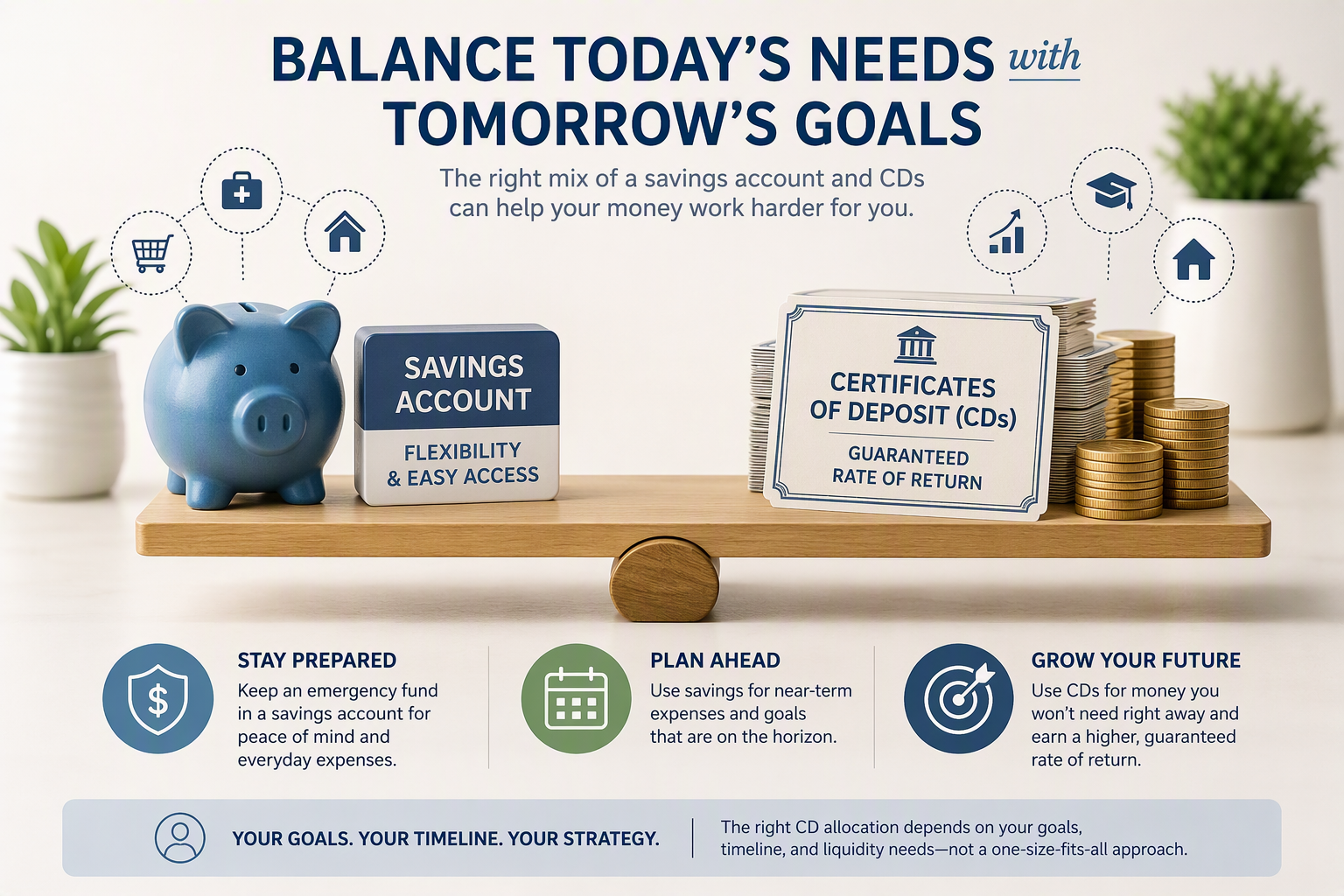
A CD may be a better choice for savings you can leave untouched until a specific maturity date, since the fixed interest rate usually provides a greater return than a traditional savings account.
I often say that it's not necessarily an either-or decision. Savings accounts and CDs often serve different purposes, and many successful savers use both as part of a broader strategy.
Rather than asking which account is better, consider how each one can support a different part of your overall savings strategy.
How to Decide How Much to Put in a CD
There's no one-size-fits-all answer to how much money you should keep in a certificate of deposit. A good rule of thumb is to put only the savings you won't need until the CD matures.
One helpful way to think about it is to divide your savings into three categories: emergency savings, near-term needs, and money you can comfortably set aside for longer-term goals.
1. Keep Your Emergency Fund Accessible
Before investing in a CD, it's important to have an emergency fund in a savings account or other readily accessible account. Financial experts generally recommend keeping three to six months' worth of essential living expenses set aside for unexpected events, such as a job loss, medical emergency or major home or vehicle repair. Because CDs typically charge an early withdrawal penalty, they're generally not the best place to keep money you may need at a moment's notice.
I generally encourage customers to think of savings in layers. Emergency funds should remain accessible, while money earmarked for future goals may be appropriate for CDs.
2. Set Aside Money for Upcoming Expenses
Next, think about any expenses you'll need to cover during the life of the CD. If you're planning to buy a car, pay college tuition, renovate your home or take a vacation within the next several months, keeping those funds in an accessible account may provide more flexibility. Matching your savings to your timeline can help you avoid withdrawing money from a CD before it matures.
3. Put the Rest to Work
Once you've accounted for your emergency fund and near-term expenses, you may consider putting the remaining savings toward a CD if you won't need the money until the end of its term. With a CD, your money remains on deposit for a fixed term, which can help your savings earn a predictable return. For long-term financial goals, a CD can be a useful way to earn more on money you can afford to leave untouched.
Building a CD Strategy
After you've decided how much of your savings you're comfortable setting aside, the next step is choosing a CD strategy that aligns with your financial goals and timeline.
You can start by thinking about when you'll need the cash. If you're saving for a specific expense, such as a wedding, tuition payment, or home improvement project, choosing a CD with a maturity date that lines up with that goal can help you earn interest while ensuring your funds are available when you need them. If you're saving for a longer-term goal and don't expect to need the money all at once, you don't have to put it into a single CD.
Some savers spread their funds across multiple CDs with different maturity dates. This approach, known as CD laddering, can provide more regular access to your savings while still allowing you to take advantage of competitive CD rates. If you're considering this strategy, it's worth learning how CD laddering works and whether it fits your financial goals.
It's also a good idea to revisit your savings plan from time to time. A new job, growing family or changing financial priorities may affect how much money you want to keep readily available versus how much you're comfortable setting aside in CDs. Reviewing your savings periodically can help ensure your strategy continues to support both your short-term needs and long-term goals.
Find the Right Balance for Your Savings
Deciding how much money to keep in a CD comes down to balancing today's needs with tomorrow's goals. By keeping enough savings readily available for emergencies and near-term expenses while setting aside money you won't need right away, you can create a strategy that offers both flexibility and the opportunity to earn more on your savings.
I believe the most effective CD strategy is one that supports your goals, maintains appropriate liquidity, and allows you to stay flexible as financial needs evolve.
If you're unsure how CDs fit into your overall financial plan, connecting with a personal banker can help. Together, you can build a savings plan that balances accessibility with long-term goals and choose the accounts that best support your financial future.
About the Author
Ben Joergens is Director of Financial Empowerment at Old National Bank and a Certified Financial Education Instructor with over 26 years of banking experience. As a nationally recognized financial educator, Ben received the ABA George Bailey Distinguished Service Award (2015) and the NFEC Financial Educator of the Year Award (2017).
He specializes in helping consumers build financial confidence and achieve their financial goals. In addition, Ben is the host of Old National's Real-Life Finance Podcast which focuses on everyday financial solutions that empower listeners to build the financial future they richly deserve.
