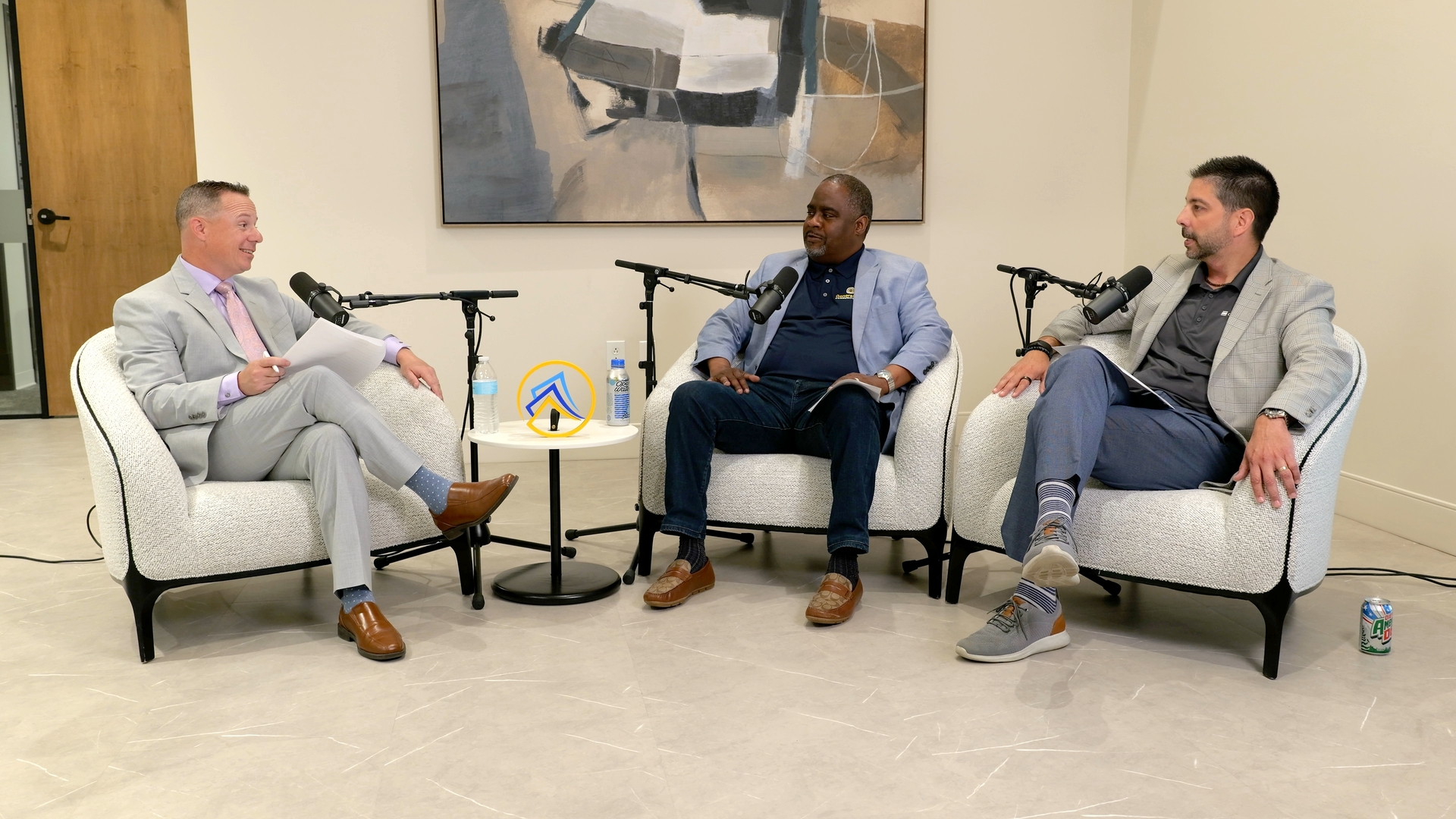
Real-Life Finance® Podcast: Generations Community Bank, Indiana’s First Minority Depository Institution
Listen wherever you get your podcasts.
In this special edition of Real-Life Finance®, we sat down with Rafael Sanchez, Old National’s chief impact officer and Indianapolis market president, and Al London, CEO of Generations Community Bank, to talk about the mission behind Indiana’s first Minority Depository Institution. From expanding access to banking services to advancing financial education and economic mobility, they share how Generations Community Bank is working to make a lasting impact in the communities it serves.
Read the transcript below, or click here to listen.
Ben Joergens:
Well, welcome to a special edition of The Real-Life Finance® Podcast on the road in Indianapolis. I am your host, Ben Joergens. We have our two esteemed guests that I'm excited about. So Rafael Sanchez, Chief Impact Officer here at Old National Bank and Al London, CEO at Generations Community Bank. So welcome to the both of you. Thanks for being here.
Al London:
Glad to be here.
Ben Joergens:
Yeah. So a lot of people may wonder what is Generations Community Bank? So we're going to talk about that, but at the beginning, I'd like you if you both can state a little bit about yourselves for our audience to get to know you guys.
Rafael Sanchez:
I defer to my team.
Al London:
I defer to the elder.
Rafael Sanchez:
Yeah. Well, thank you first for having us on the podcast. Rafael Sanchez. I'm originally from Puerto Rico. I'm an attorney by trade, but have dabbled in banking on the front end and now on the back end of my career and at one point was a CEO of electric utility here in Indianapolis. I've always been involved in the community and currently serve as chief impact officer for Old National Bank as well as Indianapolis Market President and have been the lead organizer up until its launch of Generations Community Bank.
Ben Joergens:
Fantastic. Great. Glad to have you here. Al?
Al London:
Yeah, Al London. Originally from Georgia, moved to Indiana in 1992. So this is home now for me.
Ben Joergens:
Nice.
Al London:
So I have spent 28 years in banking at my former employer and the last two years with Old National and before going into my day-to-day operation now as president, CEO of Generations Community Bank.
Ben Joergens:
Fantastic. I remember meeting you for the first time a couple years ago when everything started. And as we get into this podcast, I think that's going to be a good point to kick us off. So I think Rafael, we'll start with you. So back in the beginning, let's take us back to when this all started. How did Generations Community Bank really come to life and what role did Old National play in making that happen?
Rafael Sanchez:
It's a very interesting story. I remember to this day when Jim Ryan approached me and said, "Rafael, I've got a project for you." I was running private banking at the time, which if you think about it is really more on the wealth management side, but Generations Community Bank is more on the wealth creation side. So it's a very interesting dichotomy. He said, "We're thinking about helping launch the first Minority Depository Institution in the state of Indiana." I said, "The first what?" I didn't really know what an MDI... For short we call it. Didn't know what it was. And being the lawyer that I was and not knowing what it was, I said, "Yeah, perfect." I said, "Yes. So I'll do it." But then I started the due diligence process, started reading all about it. I read every reg there's out there about Minority Depository Institution, became familiar with the process for starting a new bank, which is very complex.
And then I got to work. This all came, by the way, as a byproduct of the very first CEO council cohort, which is a leadership program mostly designed for minority and women associates to continue developing into their careers. And Jim Ryan tasked them with... We had this vision, should we support an existing MDI or should we start our own? The answer came back pretty resounding, "Let's start our own. Indiana doesn't have one." And then the project was basically born and I was tasked to lead it at that point.
Ben Joergens:
Yeah. Fantastic. So touching upon that as we learn more about the core of what Generations Community Bank is, you mentioned an MDI, a Minority Depository Institution. For listeners that aren't as familiar, can you explain why those are so important and what they are, what the true meaning is that is?
Al London:
Yeah. So like Rafael, I had extensive career in banking, even I didn't know what an MDI was. I had to do some research. But at its core, a MDI is a community bank focusing on creating wealth for those members within our community that have been underserved and overlooked for many years by traditional banks. MDIs, our doors are open to everyone in the community, but we're very intentional in reaching out to those that's been underserved. We've all heard about the wealth gap that exists in America. So the MDIs, the way I look at it, they're on the front line addressing that issue that we all care about.
Ben Joergens:
That's great. That really is the mission of what a MDI does, right?
Al London:
Absolutely.
Ben Joergens:
And the mission of generations community banks. So how does being an MDI, or as we state... And we like acronyms by the way of banks, don't we?
Al London:
We do.
Ben Joergens:
How does being an MDI shape the way Generations Community Bank approaches lending relationships and the overall community impact?
Al London:
We are a bank, so there's a lot of similarities. We have to think about risk, safe and sound practices, but when you are built on a mission the way Generations Community Bank was designed, the community is at the heart of everything you do. So that looks like you spend more time in the community really understanding the challenges that the members of your community have. As we say, we listen first before we take action. So that factors into the types of products that we're offering. That also factors into our service model. We know that there are going to be declines that happen, but it's what we do with those declines, how we interact with the client that makes the difference.
There's a lot of what I like to call concierge level service, handholding service, walking the potential client through the decision that we've made. And that's not just on the decline side, that's also on the approval side. Making sure folks understand because the real gap is access and then once they have access, they need to understand how to properly manage the access, how to take advantage of the access and leverage it so they can reach their goal financially.
Ben Joergens:
Yeah. So it sounds like too, relationships are... And like in banking... And that's huge and it's not always a no, maybe it's a, "Not now." Or, "What can we do to get you to that point of being..."
Al London:
Absolutely.
Rafael Sanchez:
But if I can double click on that, I like to call an MDI is kind of like the hybrid vehicle of banking. So hybrid vehicle is part, gas, part electric and so an MDI is part for profit bank and part almost non-for-profit. And the not for-profit piece of it, which is really not a non-for-profit, but it has attributes of a non-for-profit insofar as the things that Al was talking about with the service model and really taking the time to explain a client who's been declined for a loan, "Here's how you fix your credit. Let's put a plan together to do it." You're not charging a fee for service. That's what a nonprofit would do, right?
Ben Joergens:
Yeah.
Rafael Sanchez:
So in a traditional banking system, you typically, you have a denial and then you move on. The pressures of having a return for shareholders, engaging in other transactions, it rears its head. And so what an MDI does is that it lines up the mission piece of it all the way from the shareholders that invested in it to the management, to the board. Everybody's aligned and says, "It's okay if you spend more time with customers than you ordinarily would, even if you're not making any money or making a profit because you're moving the needle on the social impact that this bank was designed to deliver."
Ben Joergens:
Absolutely. And that's a key thing. The core focus of our Real-Life Finance podcast is financial education. So it sounds like a lot of the folks with Generations Community Bank spend a lot of time doing that education to really help them get to where they want to be.
Al London:
I'll just add, we've had our doors open now... We just had our grand opening on April 23rd and to Rafael's point, the feedback we're getting from those that voted with their feet to come bank with us, the number one thing they're citing is this service. The amount of attention and time that the staff is taking with them just to explain their deposit relationship. We've already had some folks that we had, to your point, a not now conversation, but they're walking out saying, "Thank you. Thank you for explaining it to me. This is a place I want to be." So we know that it works and it's needed.
Ben Joergens:
That's awesome. And a tip for our viewers, if you don't know something you want to know, just ask. That's the key is we want to help you. The more we know about you, the more we can help you. So let's move on to the relevance in the community impact side. So MDIs right now in today's world, why do they matter now, especially in today's financial and economic landscape?
Al London:
I'll start us off with that. I think they've always mattered. The wealth gap has existed far too long and it's not narrowing. If anything is widening. So we need more financial institutions that, to Rafael's point, is willing to take the time to educate and empower members of that community. I think regardless of what community you're in, everyone wants to see a thriving community, but to really get to a thriving community, everyone has to have the access and the service to be the best version of themselves financially. So I can't see a community thriving to its full potential unless there are financial institutions like MDIs that exist to help. There's been studies that have shown that when there's an MDI in the community, you see improved credit outcomes, you see improved credit scores, you see an increase in homeownership. I don't know about you, but if you're increasing those things, you're strengthening the economy.
Ben Joergens:
Absolutely. It's a big win.
Al London:
Right. And there's a ripple of that from there.
Ben Joergens:
Yeah. The stronger our communities are, the stronger everything becomes.
Rafael Sanchez:
And I think it's important to note that there's 155 MDIs in the country. We're number 155. By the way, when I started this... Or 152 or 147, I can't remember. It was amazing. The number of MDIs keep growing. But why would the FDIC, who created the MDI program back in 1989, create this special vehicle called the Minority Depository Institution if it operates just the same as a traditional bank, otherwise it would just be a regular bank, right?
Ben Joergens:
Right.
Rafael Sanchez:
The reason that they exist in and of itself is proof that they do something different, that they deliver service in a way unlike the traditional banks because you have to qualify to become one. And so I'm looking forward to the impact, but it's all about improving the lives of the community and creating economic mobility and really spending the time to really move the needle on all the things of the wealth gap. These are facts and figures that are well known to many, but just to put a fine point on it, credit scores in some of the underserved and underrepresented communities are on average are 52 points lower than mainstream. 52 points in the banking world is the difference between an acceptance and a denial. And if you do get approved, you get approved at a higher rate-
Al London:
Higher interest rate, yeah.
Rafael Sanchez:
... to compensate for the risk. Homeownership rates lag depending on which demographic you're part of as low as 30% swing of lack of homeownership compared to mainstream. There's just all kinds of real facts and figures. And so obviously Al and his team are going to work hard every day to help sort of mitigate that, but it's not a silver bullet and it needs an ecosystem of multiple organizations, community assets, et cetera, to really put a dent in it, but we're in a step in the right direction and we're so proud that we have the first MDI in the state.
Ben Joergens:
Yeah.
Al London:
And I want to say something, Raf, you're always talking about this and I love it when you bring this point up, that all those stats are real. MDIs are important. But that doesn't mean we're taking on risky loans.
Rafael Sanchez:
Exactly.
Al London:
I love it when you talk about that. We're not here to take on risky loans. We are a bank, but that's where the education comes in. That's where it's more important. I think sometimes...
Rafael Sanchez:
You get confused with subprime lending. Or it's something lesser than a bank. It's not. It's a bank and the regulators will hold you to the same level. There's no free pass. You can't just willy-nilly do all the loans that you want to do. You've got to be prudent and engage in safe and sound banking practices. But it's not about appetite necessarily for risk. It's about appetite to make an impact and it's about taking the time to help those individuals and families get off their feet to get the resources that they need and again, not charging a fee for it. It's okay to spend time. It's okay to spend half a day with someone. That is the essence of an MDI.
Ben Joergens:
That's awesome. So we're here in Indianapolis. Enjoyed my drive up this morning. A lot of locations could have been picked here. Why Indianapolis for Generations Community Bank and what makes Indianapolis unique for this spot?
Rafael Sanchez:
I can probably start with that, but from an Old National Bank perspective, it just made sense to do it in the capital of our home state. We've been around since 1834. We're the largest bank headquartered in Indiana. We think about what kind of legacy we as an institution, as a community bank, we pride ourselves in being a community bank. We want to give. We want to give to our home state who's treated us so well for so many years. We couldn't think of a better place to start and to put this in Indianapolis. And so it just kind of morphed into that way. And of course the last bank here started like 30 years ago. Even the regulators were at a loss. They're like, "Okay, we don't know..." This is for some first time experience. They weren't around when the last bank was formed. So they were excited about this. I'm sure Ben, you saw the grand opening-
Ben Joergens:
I did.
Rafael Sanchez:
... and over 400 people came. When's the last time you saw a bank opening or a banking center opening?
Ben Joergens:
Or any [inaudible 00:14:41].
Rafael Sanchez:
Yeah. You maybe have 40 people there, 50 people there, maybe 75% are from your own workforce. That was the entire community showed up and it just shows not only the appetite that there is for something like this, but I think the celebration, the joy, the gratefulness that in this current environment that something like this could come to fruition.
Ben Joergens:
Actually that's what I was going to ask next was, how does the community in Indianapolis here really influence the way that Generations Community Bank operates and serves its customers? And it sounds like obviously there's a great push for this from the whole community. Anything you want to expand on that, Al?
Al London:
Yeah. To Rafael's point, over 400 people showed up. That's amazing.
Ben Joergens:
That's awesome.
Al London:
At a grand opening, regardless if it's banking or not, 400 people, wow. So every time I think about it, I have to say thank you Indianapolis for showing up and supporting us. But there was an idea that I wish I could take credit for it, but the team came up with. At the grand opening, there was a board that we had and it says, "What does financial freedom mean to you?" And when you talk about how does the community shape our thoughts and our decision making, first of all, again, we listen, we're a bank that listens first. And every day when I walk in and out the building, that board is in our foyer with comments from members of the community. "What does financial freedom mean to you?" And it's a great reminder to not just me, but to the whole team of what's the purpose of our mission.
And when you read things like saying, "Financial freedom means I get the chance to spend more time with my kids, with my family, it positions me to give back," that is a great reminder. So we take those things in consideration when we're talking about our products and our service model because we're incorporating the voice of the community.
Ben Joergens:
I'm so glad you said that because we've surveyed so many people over the time that I've been in this role, 12 years or whatnot, and financial freedom is the one thing... And we're happy to see it growing from an education space in the schools now. Indianapolis was a big push on that as well. So one thing I'm impressed with Indianapolis is this city just grows and so much is happening here in Indianapolis. So as the city continues to grow, how do you see Generations Community Bank growing alongside that over time?
Al London:
One customer at a time. Old mentor of mine told me, "You can't boil the ocean, Al, but you can one cup at a time." So it's one customer at a time. As we talk about it inside the four walls of Generations Community Bank, we talk about the inside out model. We're really heavily concentrating on the fine line radius around every location we have. We're starting out with two locations. And I want to emphasize the start, the long-term goals that we will grow and take GCB across all of Indiana, but you kind of got to crawl before you walk and before you run. But it's an inside out model where we're building meaningful relationships with leaders from the community. That includes the non-for-profit community, neighborhood associations, small business owners. We want to hear from them because it's their community. We're there to serve. We don't want to show up as if though we have all the answers. We need to incorporate... And again, I can't say it enough, we're a bank that leads by listening first.
Ben Joergens:
That's great.
Rafael Sanchez:
And again, if I can add, let's not forget our board for Generations Community Bank, all local individuals or have local ties and that matters to the community. And I think the secret sauce of why Generations Community Bank, in my opinion, was so successful to get the regulatory approvals to do the capital raise, be oversubscribed is in great function of reflection of the local leadership with Al and his team. People recognize who they are, they know them. There's trust capital there. They recognize the people who are on the board. This is a very proud city. It's proud to have their own things and I think the community will continue to support it as they continue to grow and as the community continues to grow, Al can deliver more and more impact across our state knowing that this is a Indiana led, Indiana born bank, based bank and the only mission driven bank in the state. And I think I can't wait to see what the next 5, 10 years look like.
Al London:
Absolutely.
Ben Joergens:
I think it's really cool too. We talk a lot about relationships and you look at Old National Bank and Generations Community Bank working together. I think you can learn a lot from each other and I think that education from your background and from the attorney and the banker side and working together, I think it's just an awesome thing that you guys have done here. And as we get ready to wrap up, you mentioned that Generations Community Bank shows up differently for families, for small businesses. Anything that you want to add to that as what makes it a little bit different outside of maybe a regular bank or whatnot?
Al London:
Yeah. I got to talk about our team, the staff. I am very fortunate that the members of the team said yes to this journey. When you think about recruiting talent to come to a startup bank in many cases, some of our first hire, we hadn't even been approved yet by the regulators. So we asking people to leave their employment to come to a bank that-
Rafael Sanchez:
Should be open.
Ben Joergens:
May not or happen.
Al London:
Right. We don't know if it's going to get open, but our chief credit officer, Kyle Middleton, David Bratton, our CFO, Michelle Carrera, our chief compliance risk officer, Leo Lopez, our chief banking officer, just to name a few, said yes. And I thank God every day that they did. So I think the diversity of our team is a unique factor about Generations Community Bank because members from the community can walk into our office and see someone that they can connect with. And I think that's often sometimes overlooked and forget how valuable that is.
Ben Joergens:
Yeah. Well, I love it. So you had 400 people show up at this opening. Obviously your community's behind you here. So if there's people out there listening that really want to support the mission of Generations Community Bank, what can they do, Al?
Al London:
They can come visit us one of two ways, at our main office at 2110 North Illinois Street, just north of downtown Indianapolis, or visit us at our website at www.mygc.bank. But I really want to invite folks to give us an opportunity to earn your business as a depositor. Be an ambassador. Come visit us. I think when you walk through the doors and you see what we've done with the support of Old National Bank, and I always have to give a shout-out to Jim Ryan and my brother... I don't say my friend, sitting next to me, Rafael Sanchez and many others for supporting us and then our shareholders. But when you visit, you will feel that difference that we're talking about. And I hope that folks will give us an opportunity to earn their business as a depositor and then also consider us when you have a lending need.
Ben Joergens:
Fantastic.
Rafael Sanchez:
And I would add that... So I love to tell people it's okay to have more than one bank. So no one's asking for them, "You bank with XYZ bank for 30 years, I'm not going to switch banks." Don't switch banks. Just open an account.
Ben Joergens:
Just add it.
Rafael Sanchez:
Add it and parked some money there because in that way you're supporting the bank and it's still your money, but you're supporting the bank and its activities and it's just going to help Generations Community Bank grow and then deliver more impact to more Hoosiers.
Ben Joergens:
That's fantastic.
Al London:
If I can add one thing too, I think it's important to say that again, this all started with the vision of the leadership of Old National and getting their board to get on board. And then Rafael talked about the CEO council, but there's another unique makeup about Generations Community Bank that I think is special. When you look at the makeup of our shareholders, we have 67 shareholders. Of that 67, 12 are other banks.
Ben Joergens:
Really?
Al London:
Right. That's very, very special. And I don't think that would happen if it wasn't for the vision and leadership of Jim Ryan and his team. So again, just want to thank all of our shareholders, but I always like to point that out because I think that's very unique to the point to where our regulators even say, "Wow, we've not seen this happen before." So there's a lot of historic attributes to Generations Community Bank.
Ben Joergens:
It just shows the power of what can happen when people work together and utilize each other's relationships and putting that together great things can happen.
Al London:
When you put the community first, amazing things can happen.
Ben Joergens:
Awesome.
Al London:
Absolutely.
Ben Joergens:
Well, Al, Rafael, thank you guys for joining us on this traveling episode of the Real-Life Finance Podcast. We wish you the best, Al, and I know that we'll be there supporting you and we hope our followers and listeners do as well. So thank you guys.
Al London:
Thank you.
Rafael Sanchez:
Thank you.
Disclosure:
Old National Bank, member FDIC and Equal Housing Lender. The information provided in the Old National Bank's Real-Life Finance® Podcast is for general informational purposes only and does not constitute financial, legal or professional advice. The views and opinions expressed by the host and guests are their own and do not necessarily reflect the views of Old National Bank. While we strive to provide accurate and up-to-date information, Old National Bank makes no representations or warranties of any kind, express or implied about the completeness, accuracy, reliability, suitability, or availability with respect to the podcast or the information, products, services, or related graphics contained in the podcast for any purpose. Any reliance you place on such information is therefore strictly at your own risk. In no event will Old National Bank be liable for any loss or damage, including without limitation, indirect or consequential loss or damage, or any loss or damage whatsoever arising from loss of data or profits arising out of or in connection with the use of this podcast.
