Best Matches
Personal Savings Accounts
Compare the benefits of Old National Bank savings accounts to find the right option. Convenient savings, money markets, IRAs, and CD accounts are available.
2,455 results found
-
6 Quick Money Moves to Make Before the Year Ends
Six practical things you can do before the end of the year to set yourself up for a stronger financial future.
-
What To Do With Excess Funds In Your Child’s 529 Plan—A Good Problem To Have
What do you do with "extra" funds in your child's 529 Education Savings Plan after they've finished college, or gone in a different professional direction?
-
Calculator: Save for How Long
The Old National Bank save-for-how-long calculator lets you estimate how many months or years you need to save at a given pace to reach your savings goal.
-
Five Tips for Becoming a Financially Successful Couple
Having helped hundreds of couples retire, while also recently celebrating five years of marriage, we’ve learned a thing or two about navigating
-
Bucket Budgeting: An Easy Way To Manage Cash Flow
Like dieting or exercise, budgeting requires consistency to produce results. But budgeting can be difficult to make into a habit, as it can feel
-
8 Steps To Take If You Lose Your Job Because Of Coronavirus
These are crazy times that we are living in as the current epidemic is shaking the world. We’ve now seen jobless claims top 30 million over the last six weeks – many of them due to the novel coronavirus. In case you’re keeping track, that’s more layoffs than jobs created since the Great Recession. Perhaps you’re newly
-
How can I send a wire transfer?
To send money to both personal and business accounts in the US and internationally, visit your nearest Old National Banking Center.
To learn more about domestic and international wires, including wire transfer fees, visit our Business Wire Transfers page or our Personal Wire Transfers page.
-
Q&A on Credit and Debt
Have questions about credit? The Old National credit and debt Q&A can help. Learn about using credit cards, credit scores, repairing credit and more.
-
How do you write a check?
To write your check, fill out the fields carefully and sign at bottom right. We’ve included a properly filled out check below, as an example.
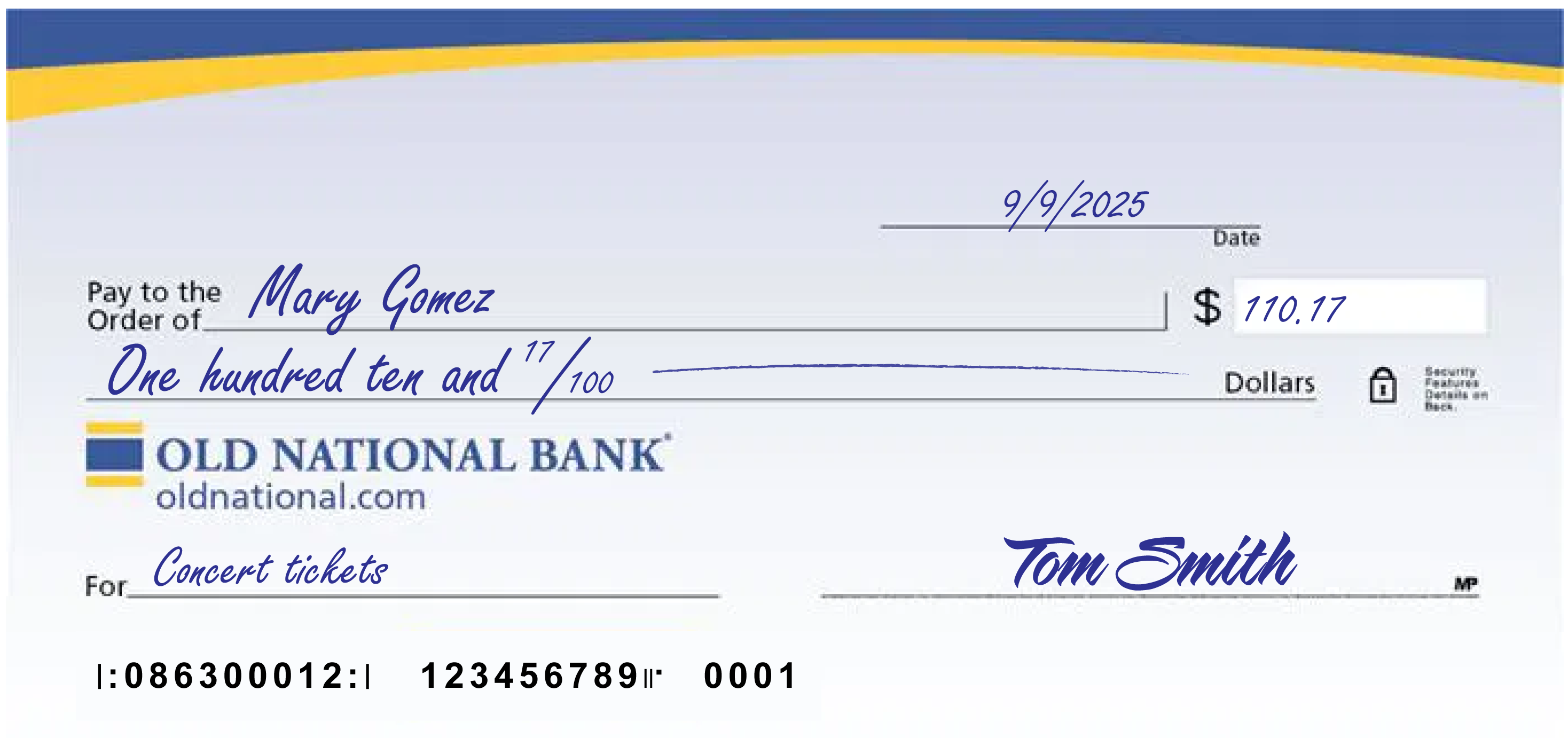
A few notes:
- The date at the upper right can be any standard format that includes the day, month and year.
- Write the full name of the person, business entity, or organization who is receiving the check in the “Pay to the Order of” field.
- The box at the right is for a numerical representation of the amount you’d like to pay the recipient.
- The line with “dollars” at the end is where you write out the amount you’d like to pay the recipient in words; write the cents as a fraction XX/100; if there’s extra space, draw a line until “dollars” so that no one can adjust the amount you wrote.
- The lower left field is for personal notes; this is optional. Some people like to write what the check is for, so they can remember when reviewing their records; If you’re paying a specific bill, you may be asked to write your invoice number or other identifying information you have on record with the company you’re paying.
- Sign the check at lower right with the signature that you use for all important documents.
- If you make a mistake on your check, you can cross it out and put your initials next to it and then write what you meant to write.
-
What is a secured credit card?
A secured credit card is a special type of credit card that allows users with no credit (or poor credit) to build (or repair) their credit score.
It works like this: The cardholder puts down a cash deposit as collateral to “secure” the card. The amount of cash put down is typically the cardholder’s credit limit. The cardholder then uses the card normally and their activity is reported to credit agencies, as it would be for any credit card.
As a result, the cardholder has the opportunity to build (or repair) their credit by making regular, on-time payments, among other things.
At Old National Bank, we offer two secured credit card options.