Best Matches
Personal Savings Accounts
Compare the benefits of Old National Bank savings accounts to find the right option. Convenient savings, money markets, IRAs, and CD accounts are available.
2,461 results found
-
3 Things Retirees Need to Do Right Now to Prepare for a Second Coronavirus Wave
With COVID-19 cases rising across the country, there's not really much debate about whether the situation is getting worse or better in the United States. In fact, the only division among public health experts now is whether we're in a second wave, or whether the first wave never ended. Sadly, things are probably going
-
6 Quick Money Moves to Make Before the Year Ends
Six practical things you can do before the end of the year to set yourself up for a stronger financial future.
-
What To Do With Excess Funds In Your Child’s 529 Plan—A Good Problem To Have
What do you do with "extra" funds in your child's 529 Education Savings Plan after they've finished college, or gone in a different professional direction?
-
How can I get a copy of a check in Digital Banking?
Once a check you have written to make payment has cleared on your Old National checking account, you will automatically have an image of it within your Digital Banking transaction history.
On a web browser
- Sign in to Digital Banking, go to My Accounts and select the checking account the check was written on. Here you can narrow your search for the image of the check.
- Under Account History, set the date range when the check cleared your account.
- Next, under "Narrow by items containing," enter keywords to help you find a specific check. You can search by check payee, check number or check amount. You can also simply search by the word "check" to pull up all checks within your designated time frame.
Once you have located the check image you are searching for, you can select it to open an image of the front and back of the check. Above the check, to the right, is a printer icon you can use to print a copy of the check.
Mobile App
- Within the Mobile App, go to Accounts and select the checking account the check was written on.
- At the very top of the screen, you will see a Search box with the words Search transactions. Here you can enter the check number (if you know it). You can also simply enter the word "check," to pull up all checks that have cleared your account.
- When searching for a check image within your Mobile App, you will not have the option to search by date range or as far back as you can within Digital Banking.
- Once you find the check you are searching for in the Mobile App, tap it to open an image of the front of the check only.
- From here, you can view or take a screenshot of the check image.
If you have trouble locating your check image within Digital Banking, please contact Client Care at 1-800-731-2265.
-
Q&A on Credit and Debt
Have questions about credit? The Old National credit and debt Q&A can help. Learn about using credit cards, credit scores, repairing credit and more.
-
How do you write a check?
To write your check, fill out the fields carefully and sign at bottom right. We’ve included a properly filled out check below, as an example.
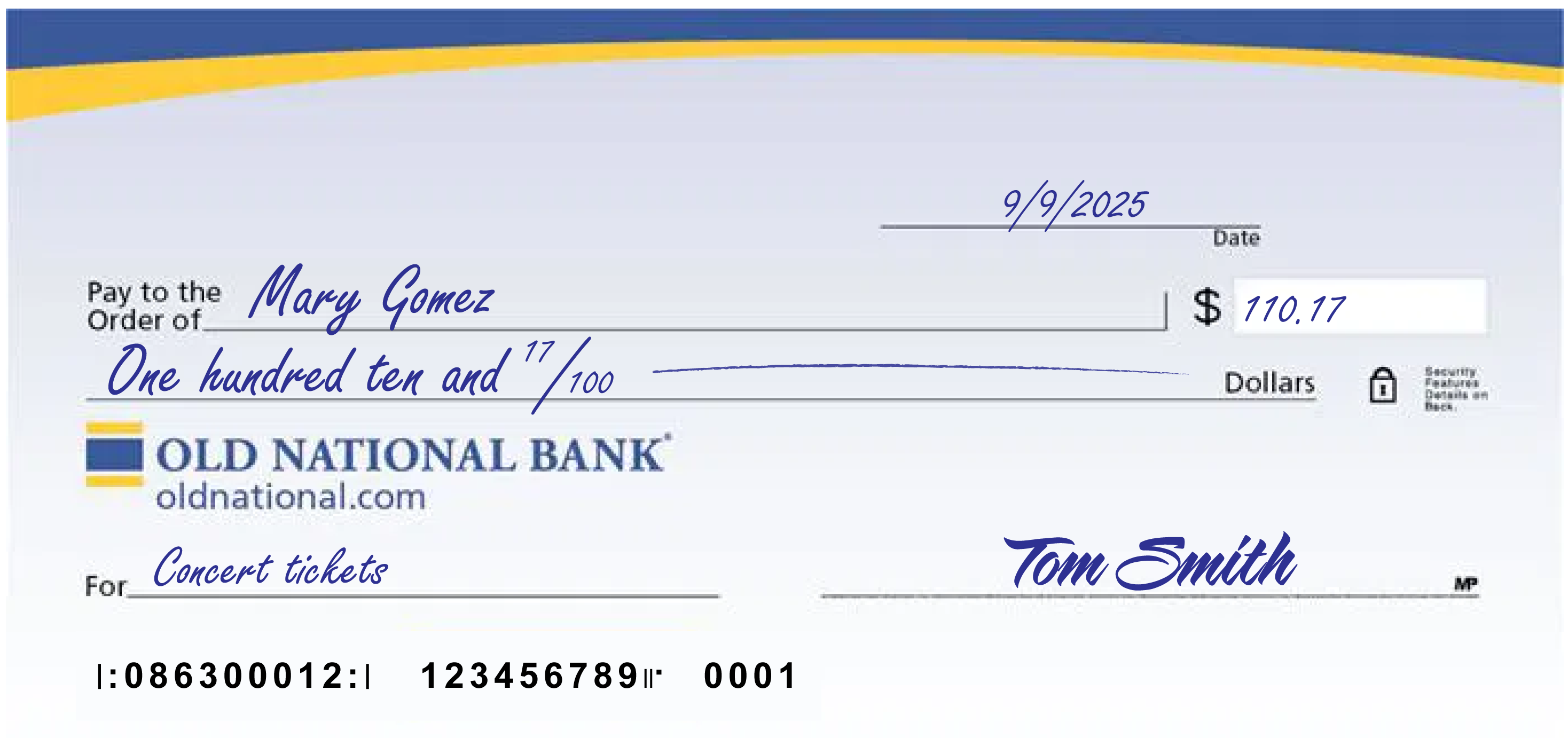
A few notes:
- The date at the upper right can be any standard format that includes the day, month and year.
- Write the full name of the person, business entity, or organization who is receiving the check in the “Pay to the Order of” field.
- The box at the right is for a numerical representation of the amount you’d like to pay the recipient.
- The line with “dollars” at the end is where you write out the amount you’d like to pay the recipient in words; write the cents as a fraction XX/100; if there’s extra space, draw a line until “dollars” so that no one can adjust the amount you wrote.
- The lower left field is for personal notes; this is optional. Some people like to write what the check is for, so they can remember when reviewing their records; If you’re paying a specific bill, you may be asked to write your invoice number or other identifying information you have on record with the company you’re paying.
- Sign the check at lower right with the signature that you use for all important documents.
- If you make a mistake on your check, you can cross it out and put your initials next to it and then write what you meant to write.
-
What is a secured credit card?
A secured credit card is a special type of credit card that allows users with no credit (or poor credit) to build (or repair) their credit score.
It works like this: The cardholder puts down a cash deposit as collateral to “secure” the card. The amount of cash put down is typically the cardholder’s credit limit. The cardholder then uses the card normally and their activity is reported to credit agencies, as it would be for any credit card.
As a result, the cardholder has the opportunity to build (or repair) their credit by making regular, on-time payments, among other things.
At Old National Bank, we offer two secured credit card options.
-
What is a line of credit loan?
A line of credit loan is a flexible loan that allows you to borrow what you need, as you need it, up to a set credit limit. As long as you follow your repayment terms, the loan remains open and you can borrow again. The most common example is a credit card, where you can continue to use it month after month, provided your account is in good standing. Other examples include Home Equity Lines of Credit (HELOCs) and revolving lines of credit for businesses.
The contrasting loan type is a fixed loan, where you’re given a set amount of funds upfront, with the expectation that you repay the loan amount with interest over a set period of time. Once you’ve paid off the loan, there’s no opportunity to borrow again; you’d need to reapply for another loan. Common examples include mortgages, car loans and personal loans.
-
How can I send a wire transfer?
To send money to both personal and business accounts in the US and internationally, visit your nearest Old National Banking Center.
To learn more about domestic and international wires, including wire transfer fees, visit our Business Wire Transfers page or our Personal Wire Transfers page.
-
An Oasis in a ‘Banking Desert’
What happens in a “banking desert”? Defined as an area lacking traditional financial services, sometimes without a banking center located in a