Best Matches
Checking Account Bonus Offer
Earn up to a $600 checking bonus when you open an Old National Everyday or Preferred Checking account and complete qualifying direct deposits.
Personal Checking Accounts
Compare Old National checking accounts. Find the option for your needs. Accounts include online and mobile banking. Online account opening is available.
2,495 results found
-
Building A Business That Becomes An Asset And Not Just A Job
Income funds your lifestyle. Assets build your net worth.
-
Is there a limit on how many people can be in a banking center?
We have re-opened our banking centers and are no longer limiting the number of people who can be inside the lobby at one time. Appointments continue to be accepted and encouraged.
-
Do I need to wear a protective mask inside a banking center?
Consistent with CDC guidance, we ask those not fully vaccinated to please wear a face mask while in the banking center.
-
How do I place a stop payment on a check or pre-authorized payment?
Please be aware that a stop payment fee of $38 per item applies. You can submit a stop payment request in one of several ways:
- For checks, log in to Online Banking. Go to Additional Services and choose Stop Payment. Follow the on-screen instructions. You can also place a stop payment for a check within our Mobile App.
- For checks and electronic transactions, visit any Old National banking center or call Client Care at 1-800-731-2265.
- When requesting a stop payment, you will need to provide the date, the amount, and the number of the item, together with the name of the payee.
- Once a stop payment is placed, and the form has been signed (when applicable), stop payment orders remain effective for up to six (6) months from the date authorized.
- Please note, that even though a stop payment request goes into effect immediately, you may still see the transaction attempting to clear your account within Online Banking. If this happens, rest assured that the transaction will be returned during our nightly processing of accounts.
-
How can I send a wire transfer?
To send money to both personal and business accounts in the US and internationally, visit your nearest Old National Banking Center.
To learn more about domestic and international wires, including wire transfer fees, visit our Business Wire Transfers page or our Personal Wire Transfers page.
-
How do you write a check?
To write your check, fill out the fields carefully and sign at bottom right. We’ve included a properly filled out check below, as an example.
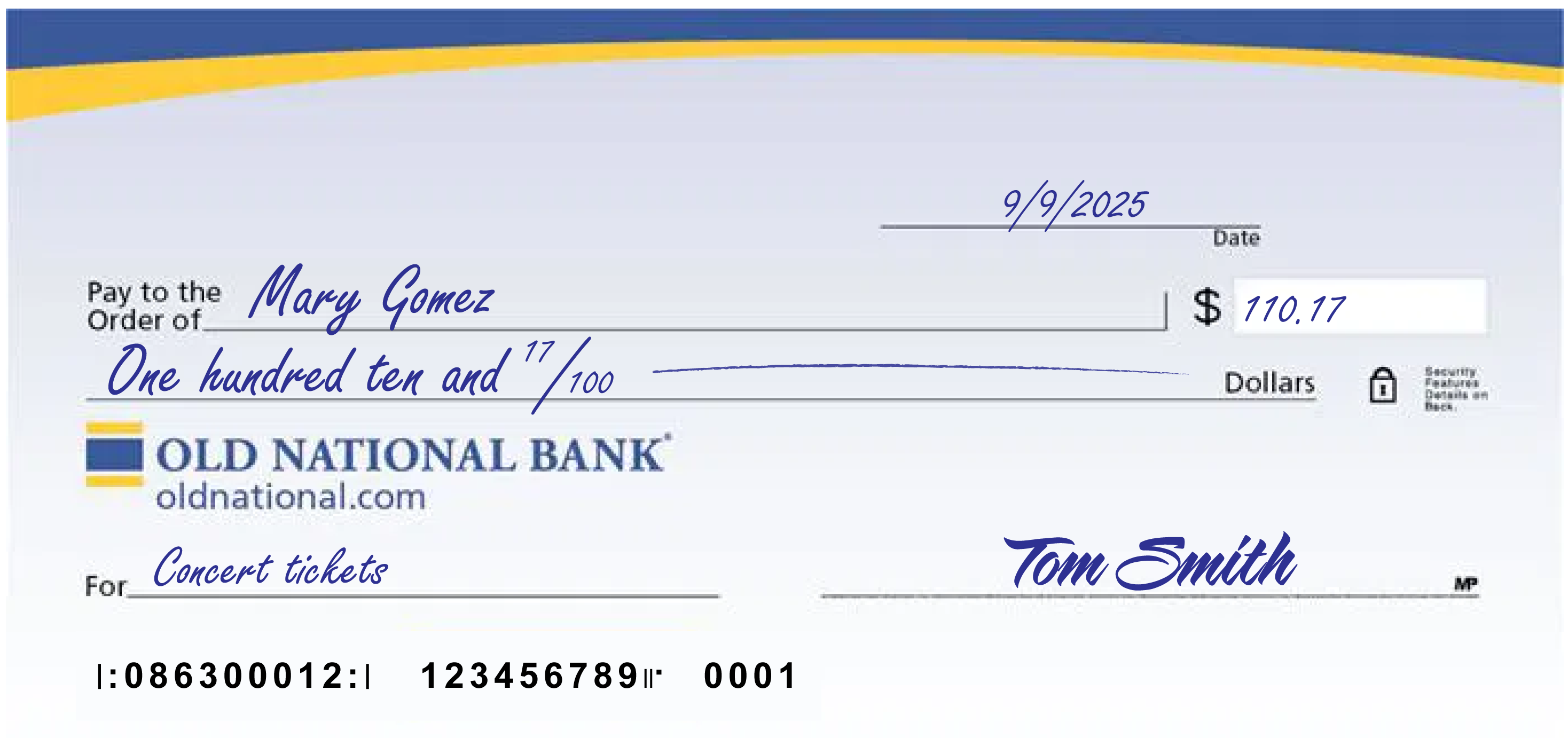
A few notes:
- The date at the upper right can be any standard format that includes the day, month and year.
- Write the full name of the person, business entity, or organization who is receiving the check in the “Pay to the Order of” field.
- The box at the right is for a numerical representation of the amount you’d like to pay the recipient.
- The line with “dollars” at the end is where you write out the amount you’d like to pay the recipient in words; write the cents as a fraction XX/100; if there’s extra space, draw a line until “dollars” so that no one can adjust the amount you wrote.
- The lower left field is for personal notes; this is optional. Some people like to write what the check is for, so they can remember when reviewing their records; If you’re paying a specific bill, you may be asked to write your invoice number or other identifying information you have on record with the company you’re paying.
- Sign the check at lower right with the signature that you use for all important documents.
- If you make a mistake on your check, you can cross it out and put your initials next to it and then write what you meant to write.
-
What is a secured credit card?
A secured credit card is a special type of credit card that allows users with no credit (or poor credit) to build (or repair) their credit score.
It works like this: The cardholder puts down a cash deposit as collateral to “secure” the card. The amount of cash put down is typically the cardholder’s credit limit. The cardholder then uses the card normally and their activity is reported to credit agencies, as it would be for any credit card.
As a result, the cardholder has the opportunity to build (or repair) their credit by making regular, on-time payments, among other things.
At Old National Bank, we offer two secured credit card options.
-
A CD ladder spreads your savings
CD ladder spreads savings across multiple CDs with different maturity dates, offering predictable returns, CD ladder grow savings, offer liquidity, access
-
5 Reasons You Need a Financial Plan
A documented, living and accessible plan makes it more likely you’ll pursue the financial future you want.
-
An Oasis in a ‘Banking Desert’
What happens in a “banking desert”? Defined as an area lacking traditional financial services, sometimes without a banking center located in a